
The Ultimate Guide to Construction Marketing Budgets
10 minute read
Marketing budgets sit in the same category as vehicles, insurance, software, rent, wages, and fuel. You can debate the size of the line item, but once you are running a real business, you do not get to debate whether it should exist.
Most businesses in the construction sector learn this late, usually after a quiet stretch, or after a competitor starts showing up everywhere and begins winning work. The mistake is treating marketing as a project. Something you turn on when you feel like it, then switch off when the projected work looks healthy.
Businesses do not behave that way with any other essential cost. They do not pay rent “when it suits.” They do not fill up the ute “when they remember.” Marketing works the same way. If it is stop-start, you pay for activity but random activity on its own never builds momentum, I would say this is easily 95% of the industry, maybe more...
At its simplest, marketing has three jobs.
First: it makes sure the right people know you exist.
Second: it helps them quickly understand what you do, and whether you are relevant to the kind of work they need.
Third: it keeps you in the mix long enough that when timing lines up, you are not starting from zero.
Mark Ritson frames it more plainly: “Marketing is the price you pay for being easy to choose.”.


How much should a construction sector business spend?
Across many industries, 10 percent of gross profit is a common benchmark. From our experience, construction often lands lower. Not because it is less important, but because the work has historically been relationship-driven and referral-heavy. That model still exists, but it is less dependable than most owners want to admit, especially when the market tightens and more companies compete for the same jobs.
In practice, what we see most often is:
5 to 7 percent of gross profit is a realistic benchmark for businesses that want steady growth and consistent presence in the market.
3 to 4 percent can be enough for established operators with strong referral flow and a stable niche.
Under 3 percent, Brand awareness is effective, results are still possible, but the margin for error shrinks and the ramp-up is slower.
It is not a set rule, but It does seem to be a pattern.
Here’s what those benchmarks look like when you put numbers against them:
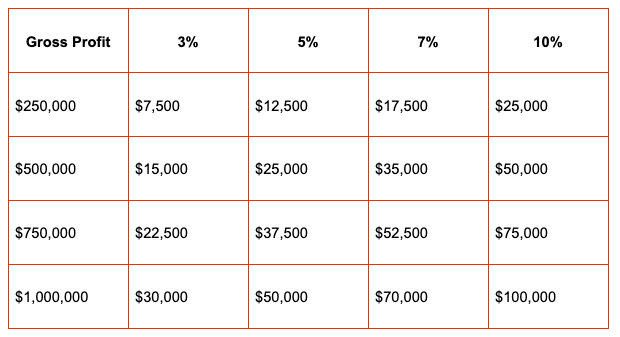
To be clear, the point of this table is not to shame businesses into spending more. It is to give owners a way to think about marketing as a proportional cost, rather than an emotional one.


Where to start
Those percentages are benchmarks, not a starting point.
Many businesses, even those with good gross profit, begin around $3,000 to $3,500 per month. The reason is simple. Before higher budgets make sense, the basics need to be in place. Content has to be created, the website needs structure and substance, and messaging needs to settle.
Starting smaller allows the business to build those foundations without loading on costs too quickly. As that work compounds, spend can increase in a controlled way, usually over 6 to 18 months. Higher budgets are most effective once the base is already working.
What a monthly budget actually buys
Most small businesses want a single number. “What should I spend per month?” The useful answer depends on where the work comes from and what kind of demand you’re trying to tap into, but it is still possible to give a practical ladder.
Around $3,000 per month is the starting point where marketing becomes consistent.
At this level, you are usually paying for the basics that keep you visible and active. That typically includes a regular content rhythm, social management, and modest promotion. It also allows the business to begin improving the website in small, ongoing steps, because the content you produce every month creates material to use, photos, project stories, service explanations, team presence, before-and-after proof. Over time, that builds a footprint that makes the next stage cheaper and more effective.
(See the Next Level Joinery website to see how we have applied 3 years of content and story telling)
Around $5,000 per month is where you can begin amplifying what you produce.
You keep the content and management, but you now have room to add meaningful paid distribution, often in the range of $1,000 to $1,500 in ad spend. This is where you can push the best-performing work out beyond your existing audience and bring people back to the site to learn more. It is also where you can start testing angles and offers without turning the whole operation into an experiment.
Around $8,000 per month is where multiple channels can run at once without starving each other.
The base remains content and management, because that is the fuel that drives consistency. On top of that, you can layer in SEO/AIO, Google Ads, Meta ads, or a combination, depending on whether you are targeting homeowners, builders, architects, designers, or all of the above. At this level, you are not relying on a single pathway to deliver enquiries. You are spreading risk across multiple sources and learning faster because you have more data.
This is the point where many businesses start saying, “Now we’re seeing it,” not because marketing suddenly starts working, but because enough time has passed for the market to absorb the message.
Warren Buffett’s line is useful here because it describes how habits form in business: “The chains of habit are too light to be felt until they are too heavy to be broken.” Stop-start marketing becomes a habit, and it is expensive to undo.

What to expect at 3, 6, and 12 months
At three months, most companies are still setting the foundation. Content is being captured, systems are being built, posting becomes consistent, and the website begins improving. If you are running paid campaigns, early results are often noisy because targeting, messaging, and landing pages are still being refined.
At six months, patterns tend to become clearer. You start to see which project types and messages get traction. Audience reactions are more predictable. You have enough material to tighten the story and stop trying to talk to everyone. This is also where it often makes sense to increase promotion behind what has already proven itself.
At twelve months, you see the compounding effect. For B2B businesses, enquiries often arrive with less explanation required because the market has seen you repeatedly. For homeowner markets, lead quality improves because testing has filtered out the wrong angles and the site has been tuned to convert. In both cases, the business has stopped feeling invisible.
Seth Godin sums up marketing in the construction industry: “Marketing is no longer about the stuff that you make, but about the stories you tell.” In this industry, stories are projects, processes, standards, and proof. They add up over time.
The cost of doing nothing
A significant part of the construction sector has long treated not spending on marketing as a point of pride. For years, that stance went unchallenged while demand was strong. Over the past twelve months, it has been completely exposed. Businesses that chose not to invest in their visibility were often the first to go quiet when work tightened, and in many cases that silence led directly to redundancies. At that stage, marketing stops being a philosophical disagreement and becomes a structural failure. Once employees rely on a business for income, neglecting the mechanisms that sustain demand is not neutral. It carries very real consequences for the team and their families.
Budgeting for the quiet months
Construction has seasons. Even well-run businesses feel slow periods.
This is where the most practical advice is not about tactics at all. It is about setting aside money.
Some businesses solve this by treating marketing like an internal “account,” separate from day-to-day spending. Money goes in monthly, the same way it would for wages, tax or GST, and it is used for steady marketing activity. When things slow down, that account makes it possible to increase activity rather than cutting it. It also creates space for larger items that appear occasionally, a website rebuild, a stronger campaign push, better content production, and so on.
That approach is not a marketing theory. It is basic financial discipline, applied to one of the few costs that can directly affect demand.
What to cut when money gets tight
If budgets need to tighten, the goal should be to protect what drives enquiries and protect what keeps the business visible.
The first place to look is the least effective activity, not the most uncomfortable cost.
Often, longer-term channels are the easiest to pause without immediate damage. SEO can be reduced or paused for a period, particularly if the business has already built strong foundational pages. That budget can be pushed into more immediate demand capture, such as lead-driven campaigns, retargeting, or promotion behind content that already performs.
Content volume can also be reduced, but businesses need to understand the trade. If you produce less, you need distribution to carry more of the load, because the organic side will slow down.
The businesses that handle this best are the ones with flexibility. They can reallocate quickly without dragging another supplier into the mix.
A note on hiring in-house too early
As businesses grow, owners often consider hiring a marketing coordinator. Sometimes it makes sense. Often it happens too early.
A coordinator’s wage can be $4,000 to $6,000 per month, and that’s before tools and overhead. That role usually does not replace production, ads, or specialist work. It adds internal organisation. If a business takes that cost on too soon, it commonly forces cuts in the areas that actually keep the pipeline warm.
For growing construction businesses, that trade-off needs to be understood clearly, because it can slow momentum at the exact time the business is trying to scale.
So what should you do next?
Start with a number you can carry month to month, even if it still feels a bit uncomfortable.. Make it a line item you plan for, not something you negotiate with yourself. If you have never marketed consistently, begin by building a steady base, then add paid distribution once you have something worth pushing.

You do not need to start at $5,000 a month. Most businesses shouldn’t. The goal is to build to that level as the business grows and the work becomes more predictable.
Marketing budgets are not about spending for the sake of spending. They are about staying present in the market long enough for opportunities to find you, and staying active enough to create opportunities when the market goes quiet.
A real example of how budgets actually evolve
If you want to see what this looks like in practice, the video below is worth 3 minutes of your time.
In it, Next Level Joinery walks through how their marketing budget has changed over time, and why.
It’s not a story about overnight results. It’s a practical look at how a marketing budget can grow alongside a business, rather than ahead of it.
